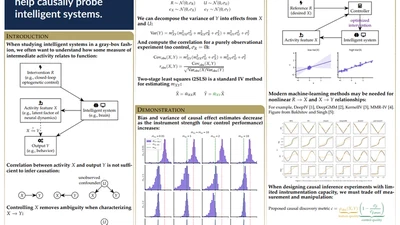
NAISys 2024 poster
A foundation for causal characterization of latent neural dynamics with limited observational and interventional capacity
Sep 28, 2024 — Oct 2, 2024
•
1 min read
PhD Candidate
Biomedical Engineering
Structured Information for Precision neuroengineering Lab (SIPLab)
I’m a PhD student advised by Chris Rozell at Georgia Tech, developing advanced closed-loop optogenetic control techniques for neuroscience. Specifically, I am applying optimal, model-based control to precisely perturb population dynamics.
I’m fascinated by the biological computational principles and how we can exploit them for next-generation AI/ML technologies. And vice-versa: how we can apply modern ML to neurotech/neuroscience, especially for building life- and time-saving brain-computer interfaces. I am looking for an industry research scientist role post-graduation.
PhD Biomedical Engineering
2019
present
Georgia Institute of Technology/Emory University
BS Bioinformatics
2015
2019
Brigham Young University
Use this area to speak to your mission. I’m a research scientist in the Moonshot team at DeepMind. I blog about machine learning, deep learning, and moonshots.
I apply a range of qualitative and quantitative methods to comprehensively investigate the role of science and technology in the economy.
Please reach out to collaborate 😃
A foundation for causal characterization of latent neural dynamics with limited observational and interventional capacity
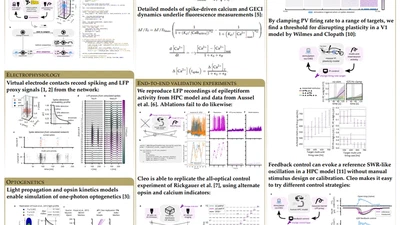
Bridging model and experiment with Cleo: the Closed-Loop, Electrophysiology, and Optophysiology experiment simulation testbed
Enhancing the Cleo experiment simulation testbed to support all-optical control, multi-channel optogenetics, and easier integration into data analysis pipelines
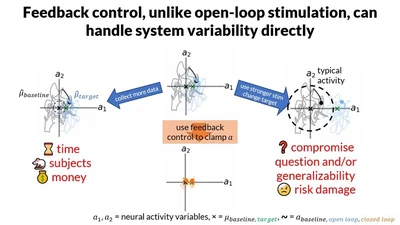
An intro to the utility of closed-loop control in neuroscience experiments and how *in silico* prototyping with `cleosim` can make it easier.
As explained here, in 2022 I had the opportunity to participate in a project bringing together neuroscience and fine arts to engage the public. In this post I want to share my …
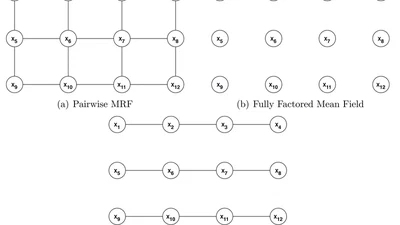
In this problem, you will investigate mean field approximate inference algorithms (Koller & Friedman1 11.5). Consider the Markov network in the above figure. Define edge potentials …
Consider a setting in which there are $D$ diseases and a patient either has ($d_i=1$) or does not have ($d_i=0$) each disease. The hospital can measure $S$ symptoms, where $s_j=1$ …
Inverse CDF sampling A simple sampling method adopted by many of the standard math libraries is the inverse probability transform: draw $u \sim \text{Unif}(0, 1)$, then draw $x\sim …
Parameter learning in Bayesian networks and Markov random fields Cost of learning CRF parameters Consider the process of gradient-ascent training for a conditional random field …
Write a function ChowLiu(X) -> A where X is a D by N data matrix containing a multivariate data point on each column that returns a Chow-Liu maximum likelihood tree for X. The tree …
Assume that a sequence $v_1,\ldots,v_T \in \{1,\dots,V\}$ is generated by a Markov chain. For a single chain of length $T$, we have $$ p(v_1,\dots,v_T) = p(v_1)\prod_{t=1}^{T-1} …
Our interest here is to discuss a method to learn the direction of an edge in a belief network. Consider a distribution $$ P(x,y | \theta,M_{y\to x}) = …
This notebook doesn't offer much in the way of explanation, but explores implementations of the basic and extended Kalman filters and compares them for different nonlinearities. …
Starboard is an exciting open-source project I learned about from a blog post by Patrick Mineault. Basically, it allows the user to run and edit an interactive notebook, including …