NAISys 2024 poster
Sep 28, 2024
·
0 min read
Abstract
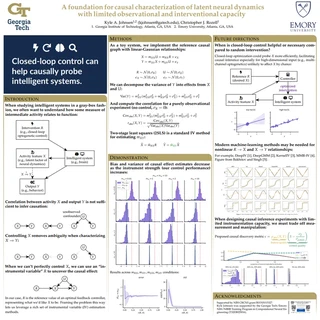
Systems neuroscience stands before an exciting opportunity to help elucidate principles of intelligent systems. Advances in recording and analysis methods have given rise to the “computation through dynamics” paradigm, which models high-dimensional activity as measurements of a lower-dimensional dynamical system. Latent dynamics thus derived have yielded impressive results in predicting behavior and nonlocal neural activity, but correlation is insufficient to demonstrate causality—for example, we cannot conclude that factor X’s correlation with behavior Y is not due to confounding variables. Fortunately, modern interventions such as closed-loop optogenetics promise the ability to control latent factors and thus enable causal inference.
To achieve this, however, a number of practical questions must be answered, including how to model the system in a way amenable to causal inference, how to estimate causal effect without perfect control over neural dynamics, and how to optimize experimental design to maximize causal discovery. Using a Markov random field as a test system, we offer preliminary answers to these questions by formulating a causal graph model that captures both causal and noncausal correlations between dependent and independent variables. By representing the controller target as an instrumental variable, we are then able to evaluate classical methods for estimating the causal effect. Our findings suggest that classical methods provide biased estimates in realistic scenarios, prompting an exploration of potential solutions. Finally, we propose a metric for optimizing the tradeoff between measurement and manipulation in experiment design to discover latent factors that are both predictive and controllable, i.e., causally characterizable. We thus aim to set the stage for a new era of systems neuroscience where we not only infer descriptions of a neural system correlating with behavior or neural processing, but ground our understanding of that system’s role in demonstrated causal relationships—crucial in reconstructing a ‘‘wiring diagram’’ of biological intelligence.
To achieve this, however, a number of practical questions must be answered, including how to model the system in a way amenable to causal inference, how to estimate causal effect without perfect control over neural dynamics, and how to optimize experimental design to maximize causal discovery. Using a Markov random field as a test system, we offer preliminary answers to these questions by formulating a causal graph model that captures both causal and noncausal correlations between dependent and independent variables. By representing the controller target as an instrumental variable, we are then able to evaluate classical methods for estimating the causal effect. Our findings suggest that classical methods provide biased estimates in realistic scenarios, prompting an exploration of potential solutions. Finally, we propose a metric for optimizing the tradeoff between measurement and manipulation in experiment design to discover latent factors that are both predictive and controllable, i.e., causally characterizable. We thus aim to set the stage for a new era of systems neuroscience where we not only infer descriptions of a neural system correlating with behavior or neural processing, but ground our understanding of that system’s role in demonstrated causal relationships—crucial in reconstructing a ‘‘wiring diagram’’ of biological intelligence.
Date
Sep 28, 2024 — Oct 2, 2024

Authors
PhD Candidate
Biomedical Engineering
Biomedical Engineering
I’m a PhD student advised by Chris Rozell at Georgia Tech, developing advanced closed-loop optogenetic control techniques for neuroscience. Specifically, I am applying optimal, model-based control to precisely perturb population dynamics.
I’m fascinated by the biological computational principles and how we can exploit them for next-generation AI/ML technologies. And vice-versa: how we can apply modern ML to neurotech/neuroscience, especially for building life- and time-saving brain-computer interfaces. I am looking for an industry research scientist role post-graduation.