Optogenetics GRC 2024 poster
Jul 21, 2024
·
0 min read
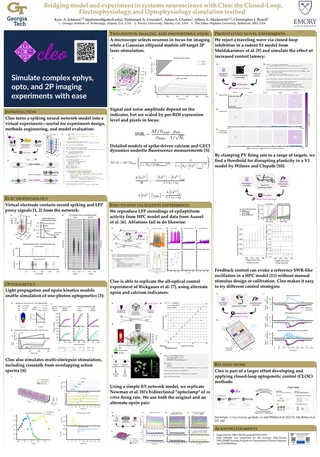
Abstract
Systems neuroscience has experienced an explosion of new tools for reading and writing neural activity, enabling exciting new experiments such as all-optical or closed-loop control that effect powerful causal interventions. At the same time, improved computational models are capable of reproducing behavior and neural activity with increasing fidelity. Unfortunately, these advances have drastically increased the complexity of integrating different lines of research, resulting in the missed opportunities and untapped potential of suboptimal experiments. Experiment simulation can help bridge this gap, allowing model and experiment to better inform each other by providing a low-cost testbed for experiment design, model validation, and methods engineering. Specifically, this can be achieved by incorporating the simulation of the experimental interface into our models, but no existing tool integrates optogenetics, two-photon calcium imaging, electrode recording, and flexible closed-loop processing with neural population simulations. To address this need, we have developed Cleo: the Closed-Loop, Electrophysiology, and Optophysiology experiment simulation testbed. Cleo is a Python package enabling injection of recording and stimulation devices as well as closed-loop control with realistic latency into a Brian spiking neural network model. It is the only publicly available tool to date supporting two-photon and multi-opsin/wavelength optogenetics. To facilitate adoption and extension by the community, Cleo is open-source, modular, tested, and documented, and can export results to various data formats. Here we describe the design and features of Cleo, validate output of individual components and integrated experiments, and demonstrate its utility for advancing optogenetic techniques in three prospective experiments using previously published systems neuroscience models.
Date
Jul 21, 2024 — Jul 26, 2024
Event
Location
Lucca, Italy

Authors
PhD Candidate
Biomedical Engineering
Biomedical Engineering
I’m a PhD student advised by Chris Rozell at Georgia Tech, developing advanced closed-loop optogenetic control techniques for neuroscience. Specifically, I am applying optimal, model-based control to precisely perturb population dynamics.
I’m fascinated by the biological computational principles and how we can exploit them for next-generation AI/ML technologies. And vice-versa: how we can apply modern ML to neurotech/neuroscience, especially for building life- and time-saving brain-computer interfaces. I am looking for an industry research scientist role post-graduation.